Dialysis Treatment Options Explained Clearly.
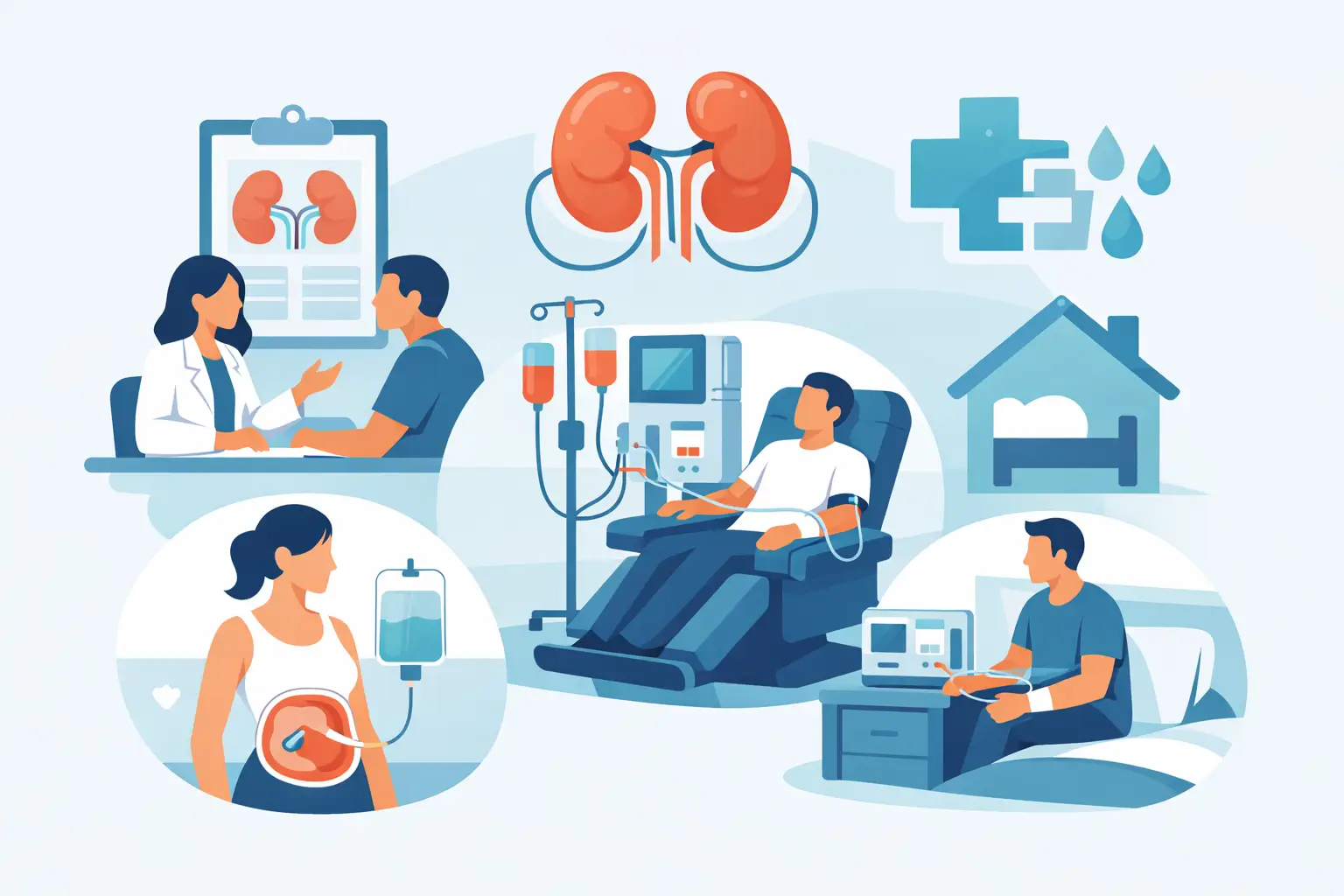
Dialysis treatment options explained clearly, including hemodialysis, peritoneal dialysis, home care, access types, and how treatment is chosen.
A patient who hears, "You need dialysis," is rarely asking for theory. The real questions come fast — Which type? How often? Where will this happen? Can I still work, travel, or stay out of the hospital? This guide on dialysis treatment options explained is designed to answer those questions with clinical clarity.
Dialysis is not a single treatment. It is a group of therapies used when the kidneys can no longer remove enough waste, salt, and fluid to keep the body in balance. The right choice depends on kidney function, blood pressure, other medical conditions, home support, urgency, vascular access, infection risk, and patient preference. For some patients, the decision is straightforward. For others, it requires careful specialist review.
Dialysis treatment options explained for patients
At its core, dialysis replaces part of the kidneys' filtration work. It does not cure chronic kidney disease, but it can stabilize the body, relieve symptoms, and sustain life while longer-term plans are organized. Those plans may include ongoing dialysis, transplant evaluation, or management of acute kidney injury until kidney function recovers.
The two main dialysis treatment options are hemodialysis and peritoneal dialysis. Both aim to remove toxins and extra fluid, but they do so in different ways and place different demands on the patient.
Hemodialysis
Hemodialysis filters blood through a dialysis machine and a specialized filter called a dialyzer. Blood is removed from the body through an access site, cleaned, and returned. This process usually takes place three times each week for several hours per session, although the exact prescription varies.
Many patients begin by thinking of hemodialysis as "the standard" option because it is the most widely recognized. It is often performed in a dialysis facility under direct clinical supervision. That structure suits patients who need close monitoring, have complex medical conditions, or are not good candidates for home-based therapy.
Hemodialysis does, however, involve treatment schedules that can be physically demanding. Some patients feel fatigued after sessions. Blood pressure changes, cramping, and fluid shifts can occur, particularly if large volumes of fluid must be removed quickly. The treatment is effective, but the timetable is less flexible than some patients would prefer.
Peritoneal dialysis
Peritoneal dialysis uses the lining of the abdomen, called the peritoneal membrane, as the filter. A catheter is placed into the abdomen, and dialysis fluid is introduced into the peritoneal cavity. Waste products and extra fluid move into that fluid, which is later drained and replaced.
This option is usually performed at home. Some patients do exchanges manually during the day. Others use a cycling machine overnight while sleeping. Peritoneal dialysis offers greater independence and can fit better around employment, family life, and travel. It also tends to provide more gradual fluid and toxin removal, which may be easier on the cardiovascular system.
The trade-off is that peritoneal dialysis requires consistent technique, a clean environment, and patient engagement. Not every patient is medically suitable. Prior abdominal surgery, recurrent infections, abdominal wall issues, or inability to manage supplies safely may make this option less appropriate.
How doctors decide between dialysis options
The phrase dialysis treatment options explained only becomes useful when it includes the reason one option may fit better than another. In nephrology, the decision is rarely based on convenience alone.
A patient with severe heart failure, unstable blood pressure, advanced frailty, or repeated hospital admissions may need the structure of in-center hemodialysis. A younger patient with stable housing, good manual ability, and a strong preference for independence may be an excellent candidate for peritoneal dialysis. Someone arriving in urgent kidney failure may need temporary hemodialysis first, even if another long-term plan is later considered.
Medical timing matters as well. Elective dialysis planning is very different from emergency dialysis initiation. When kidney function declines gradually, there is time to educate the patient, create permanent access, and compare modalities carefully. In emergency settings, the immediate priority is safe renal replacement therapy, often through a temporary catheter until a longer-term strategy is defined.
Understanding dialysis access
Access is not a minor detail. It is central to treatment safety.
For hemodialysis, the preferred long-term access is usually an arteriovenous fistula, often called an AV fistula. This is created surgically by connecting an artery to a vein, allowing the vein to strengthen for repeated dialysis use. A fistula generally offers the best long-term durability and the lowest infection risk.
If a fistula is not possible, an arteriovenous graft may be used. This uses a synthetic tube to connect artery and vein. It can work well, but infection and clotting risks are generally higher than with a mature fistula. Some patients start dialysis with a central venous catheter placed in the neck or chest. Catheters are sometimes necessary, especially in urgent cases, but they carry substantially higher risks of bloodstream infection and should not be viewed as the ideal permanent solution.
For peritoneal dialysis, access is provided by a peritoneal dialysis catheter inserted into the abdomen. Catheter function, training, and infection prevention are essential. Exit-site care must be precise, because peritonitis remains one of the major complications of this modality.
In-center dialysis versus home dialysis
Patients often ask whether home treatment is "better." The accurate answer is that it depends.
In-center hemodialysis provides trained staff, scheduled treatments, and immediate clinical support if complications arise. For patients with multiple medical problems, limited home support, or concerns about self-management, this structure can be the safest approach.
Home-based therapies, including peritoneal dialysis and selected forms of home hemodialysis, can offer flexibility and a greater sense of control. Some patients feel better with more frequent or gentler home regimens. Others find the responsibility burdensome. Storage space, caregiver availability, electricity and water reliability, and infection-control practices all matter in real-world planning.
A specialist nephrology review should address both the biology and the logistics. Good dialysis planning is not only about lab values. It is also about whether the treatment can be carried out consistently and safely over time.
What dialysis can and cannot do
Dialysis can remove waste products, manage fluid overload, help control certain electrolyte problems, and reduce symptoms related to kidney failure. It can be lifesaving in severe uremia, dangerous hyperkalemia, metabolic acidosis, or fluid overload affecting breathing.
What it cannot do is fully replace every kidney function. Dialysis does not restore normal endocrine function, does not reverse the underlying cause of chronic kidney disease in most cases, and does not eliminate the need for careful control of diabetes, hypertension, anemia, bone-mineral disorders, and cardiovascular risk.
This distinction matters. Patients do best when dialysis is understood as one part of a broader nephrology care plan rather than the whole plan.
Special situations: emergency dialysis and travel
Some patients need urgent dialysis after presenting with sudden shortness of breath, swelling, confusion, very high potassium, or rapidly worsening kidney failure. In these settings, treatment coordination must be immediate and physician-led. Emergency renal intake is not the moment for fragmented care.
Travel creates a different challenge. Patients visiting Jamaica for work, family, or vacation still require strict continuity of dialysis schedules, treatment records, access monitoring, and medication review. Vacation dialysis can be organized safely, but only if logistics are handled in advance and the receiving team has the necessary clinical information. This is where a structured, specialist-led system matters significantly.
In a physician-directed nephrology practice such as Dr. Roger N. Smith's, dialysis planning extends beyond the machine itself. It includes access review, hospital coordination, complication management, and clear communication across care settings.
Questions patients should ask before starting dialysis
Before dialysis begins, patients should understand why dialysis is needed now, which modality is being recommended and why, what type of access will be used, what complications to watch for, and whether the plan is temporary or long term. They should also ask how treatment will affect medications, diet, work schedule, travel, and emergency care.
A serious kidney diagnosis is easier to manage when the care pathway is clear. Patients should never feel that they are simply being placed on a machine without understanding the rationale.
The best dialysis choice is the one that is medically sound, realistically sustainable, and supervised with discipline. When patients receive precise education and direct nephrology oversight, treatment becomes less uncertain and far safer to live with.
Need Professional Advice?
Dr. Roger Smith and the team at Renal Services Limited offer specialized dialysis consultations and care at our offices in Jamaica.