Chronic Kidney Disease Stages Guide.
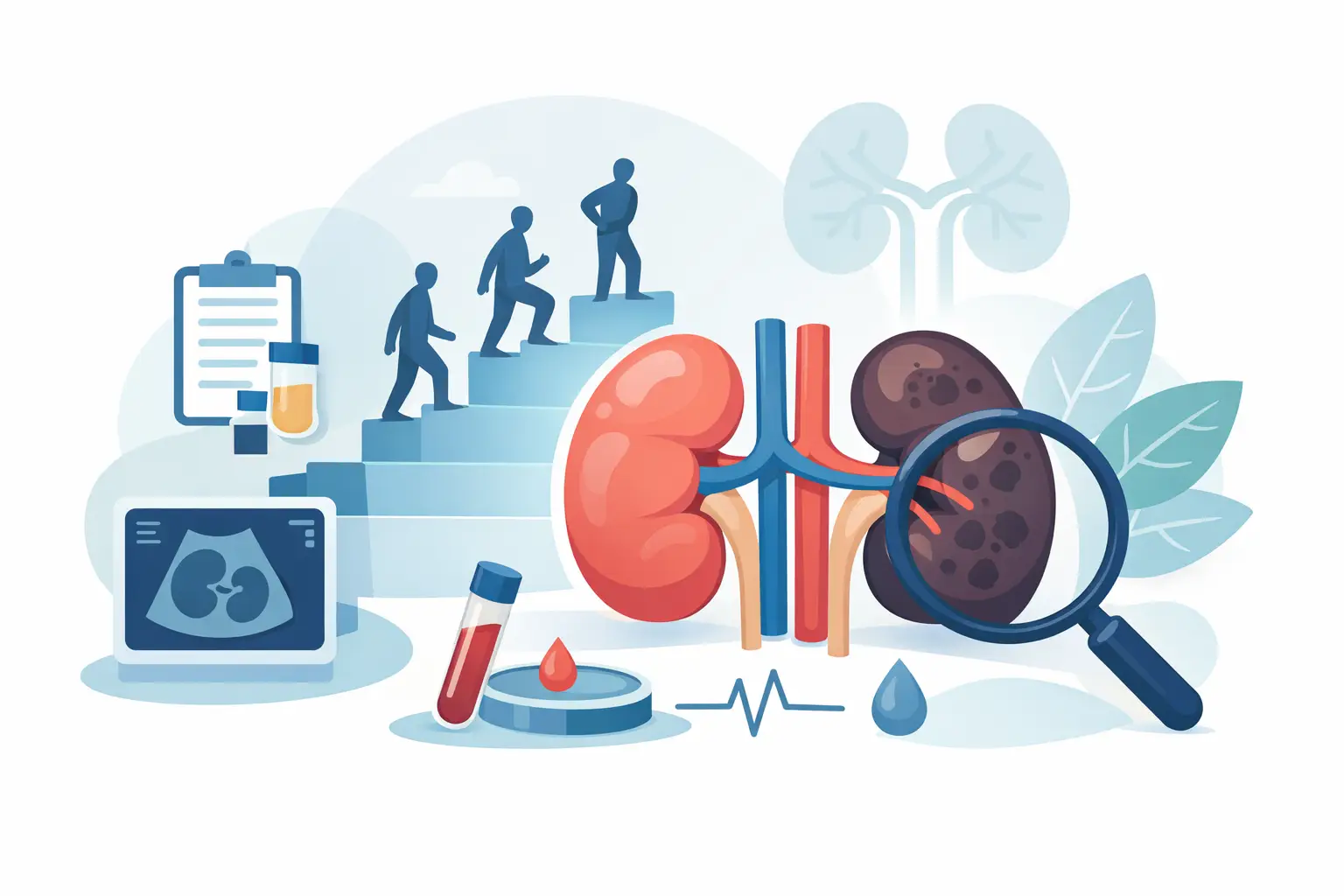
A lab report showing a reduced eGFR often raises the same question: how bad is this, and what happens next? A chronic kidney disease stages guide helps answer that question in a structured way. It gives patients and families a way to understand kidney function, risk level, and the urgency of nephrology follow-up without guesswork.
Chronic kidney disease, or CKD, is not defined by one abnormal blood test alone. It refers to kidney damage or reduced kidney function that persists for at least three months. In clinical practice, staging matters because it helps predict complications, guides treatment intensity, and determines how closely a patient should be monitored. It also helps identify when preparation for dialysis, transplant evaluation, or hospital-level intervention may be necessary.
How a chronic kidney disease stages guide works
CKD staging is based primarily on estimated glomerular filtration rate, or eGFR. This number reflects how well the kidneys are filtering waste from the blood. Higher numbers generally indicate better kidney function, although the full picture always depends on context.
A proper chronic kidney disease stages guide also includes albuminuria, which means excess protein leaking into the urine. This matters because a patient with a modest drop in eGFR but significant urine protein may face a higher long-term risk than someone with a similar eGFR and no albuminuria. In nephrology, staging is not only about where kidney function is today. It is also about where the patient is likely to be months or years from now.
Stage 1 CKD
Stage 1 means the eGFR is 90 or higher, but there is still evidence of kidney damage. That damage may appear as persistent protein in the urine, structural abnormalities on imaging, or other markers of renal injury.
This stage is frequently misunderstood. Many patients assume a normal or near-normal eGFR means there is no kidney disease. That is not always correct. If urine testing shows albumin loss, or imaging reveals kidney scarring, cystic disease, or anatomical abnormalities, stage 1 CKD may still be present. The key issue at this stage is early recognition and aggressive management of the cause, often diabetes, hypertension, autoimmune disease, or inherited renal conditions.
Stage 2 CKD
Stage 2 corresponds to an eGFR of 60 to 89, again with evidence of ongoing kidney damage. On its own, an eGFR in this range may not signal major illness, especially in older adults. The diagnosis depends on persistence and supporting findings.
Most patients in stage 2 have few or no symptoms. That does not mean the condition is harmless. This is often the point at which blood pressure control, diabetes management, medication review, and urine protein reduction can meaningfully slow progression. Missing the diagnosis here can allow silent disease to advance for years.
Stage 3 CKD
Stage 3 is divided into 3a and 3b. Stage 3a means an eGFR of 45 to 59, while stage 3b means 30 to 44. This distinction is clinically useful because complication risk increases as kidney function declines.
At this stage, CKD often becomes more visible in routine care. Patients may develop anemia, worsening hypertension, mild fluid retention, mineral and bone abnormalities, or a rising creatinine that no longer appears incidental. Fatigue can occur, though it is nonspecific and should not be blamed on kidney disease without a proper evaluation.
Stage 3 is commonly the point where specialist nephrology involvement becomes important, especially if kidney function is falling over time, urine protein is elevated, blood pressure is difficult to control, or the cause of CKD is not clear. Some patients remain stable in stage 3 for many years. Others progress quickly. That difference depends on the underlying diagnosis, albuminuria burden, cardiovascular risk, and treatment quality.
CKD stage 4 and stage 5
Stage 4 means an eGFR of 15 to 29. This is advanced chronic kidney disease and requires close specialist oversight. The goal is no longer only to slow decline. It is also to anticipate complications before they become emergencies.
Patients in stage 4 may develop more prominent symptoms, including fatigue, swelling, nausea, poor appetite, sleep disturbance, or changes in concentration. Laboratory complications become more common, including metabolic acidosis, high potassium, worsening anemia, and disorders of calcium and phosphorus regulation. Medication dosing must be reviewed carefully because drugs that are safe earlier in CKD may become hazardous at this level of function.
This is also the stage when renal replacement planning should begin if progression appears likely. Depending on the patient, that may include education about hemodialysis, peritoneal dialysis, and kidney transplantation. Vascular access planning should not be delayed until the last minute. A mature dialysis access requires time, and urgent dialysis started without preparation is usually more difficult and risk-laden.
Stage 5 means an eGFR below 15. This is kidney failure, although not every patient with stage 5 starts dialysis immediately. The decision depends on symptoms, lab abnormalities, volume status, nutritional decline, and the overall clinical picture rather than one number alone.
That distinction matters. Some patients with stage 5 feel relatively stable for a period under close supervision. Others require urgent dialysis because of refractory fluid overload, severe metabolic disturbance, uremic symptoms, or life-threatening electrolyte imbalance. Good nephrology care at this stage is highly individualized and must be coordinated with hospital-level pathways when needed.
Why urine protein changes the risk
A CKD stage does not stand alone. Albuminuria significantly modifies risk, and patients often underestimate its importance because it is less familiar than creatinine or eGFR.
When the kidney filter is damaged, albumin leaks into the urine. Persistent albuminuria is associated with faster CKD progression and a higher risk of cardiovascular events. A patient with stage 2 or 3 CKD and marked albuminuria may require more intensive management than another patient with the same eGFR and minimal protein loss. This is one reason nephrologists order both blood and urine testing rather than relying on serum creatinine alone.
Symptoms do not reliably match the stage
One of the most dangerous assumptions in kidney medicine is that serious disease always causes obvious symptoms. It often does not. Early and moderate CKD may be silent. Even advanced disease can present gradually enough that patients normalize fatigue, nocturia, swelling, or poor appetite until the condition is well established.
The opposite can also occur. A patient may feel unwell from another condition while kidney function remains relatively stable. For that reason, symptoms should inform care, but they do not replace laboratory staging. Reliable assessment requires blood pressure measurement, repeat kidney function testing, urine albumin evaluation, medication review, and in many cases imaging or additional serologic workup.
What drives progression from one stage to the next
Diabetes and hypertension remain the leading causes of CKD progression. Poor glucose control and uncontrolled blood pressure expose the kidney to ongoing structural injury. Over time, that damage reduces filtration capacity and increases urine protein loss.
Other drivers include glomerulonephritis, polycystic kidney disease, recurrent obstruction, autoimmune disease, long-term NSAID exposure, smoking, obesity, cardiovascular disease, and repeated episodes of acute kidney injury. There is no single trajectory. Some patients decline slowly over decades. Others move from stage 3 to stage 5 far faster than expected because of uncontrolled risk factors or an unrecognized primary renal disorder.
When specialist nephrology care is warranted
Referral should be considered early when CKD is progressive, the cause is uncertain, albuminuria is significant, blood pressure remains uncontrolled, or complications are appearing. It is particularly important when eGFR falls below 30, when resistant electrolyte problems arise, or when renal replacement planning may soon be necessary.
For patients already on dialysis, or for international travelers who need continuity of treatment while visiting Jamaica, coordination becomes just as important as diagnosis. Timing, access status, infection history, recent laboratory values, and dialysis prescription details all require direct clinical oversight. In that setting, consultant-led nephrology support is not an administrative detail. It is a patient safety issue.
At practices such as Jamaica Dialysis, where nephrology, hospital intake pathways, and dialysis logistics are coordinated under specialist supervision, the aim is to reduce delays between recognition of disease stage and appropriate action. That is especially relevant for patients with advanced CKD, urgent renal complications, or established dialysis dependence.
What patients should do after learning their stage
The next step is not panic. It is clarification. Patients should confirm whether the abnormality has persisted for at least three months, whether urine protein is present, what the likely cause is, and how quickly kidney function has changed over time. Those answers shape treatment far more than the stage label by itself.
They should also ask about blood pressure targets, diabetes control, medication safety, dietary restrictions, and whether imaging or additional laboratory evaluation is needed. In advanced stages, they should ask a more direct question: if kidney function worsens, what is the plan? Good renal care includes that conversation before it becomes urgent.
A CKD stage is not a verdict. It is a clinical marker that helps organize the right level of treatment, monitoring, and preparation. The most useful response is timely, specialist-guided action taken while options are still broad.
Need Professional Guidance?
Dr. Roger Smith and the team at Renal Services Limited offer comprehensive consultations, laboratory review, and personalized kidney education programs in Jamaica.